NYC BALLET
PERFORMING ARTS
INSIDE EVERYWHERE WE GO, JUSTIN PECK’S DESIGN FOR A LIVING BALLET
Everywhere We Go. Choreography by Justin Peck. Music by Sufijan Stevens. Photo Credit Paul Kolnik.
For years, I had wanted to see Everywhere We Go. The ballet premiered the same year I moved to New York, and somehow it remained on that quiet list of works I felt intuitively connected to long before experiencing them in person. Twelve years later, finally sitting inside the theater, the performance did not simply meet those intuitions. It clarified them.
NEW YORK CITY | By Pablo Herrera | Photo by Paul Kolnik
As someone educated in a school of design, I have always been drawn to choreographic thinking that understands structure without becoming imprisoned by it. What unfolds in this ballet is a geometric intelligence that feels both disciplined and fearless. Grids appear without rigidity. Lines travel with intention. Patterns threaten to fracture yet remain unmistakably organized, revealing the hand of a mind that is both demanding and deeply ordered.
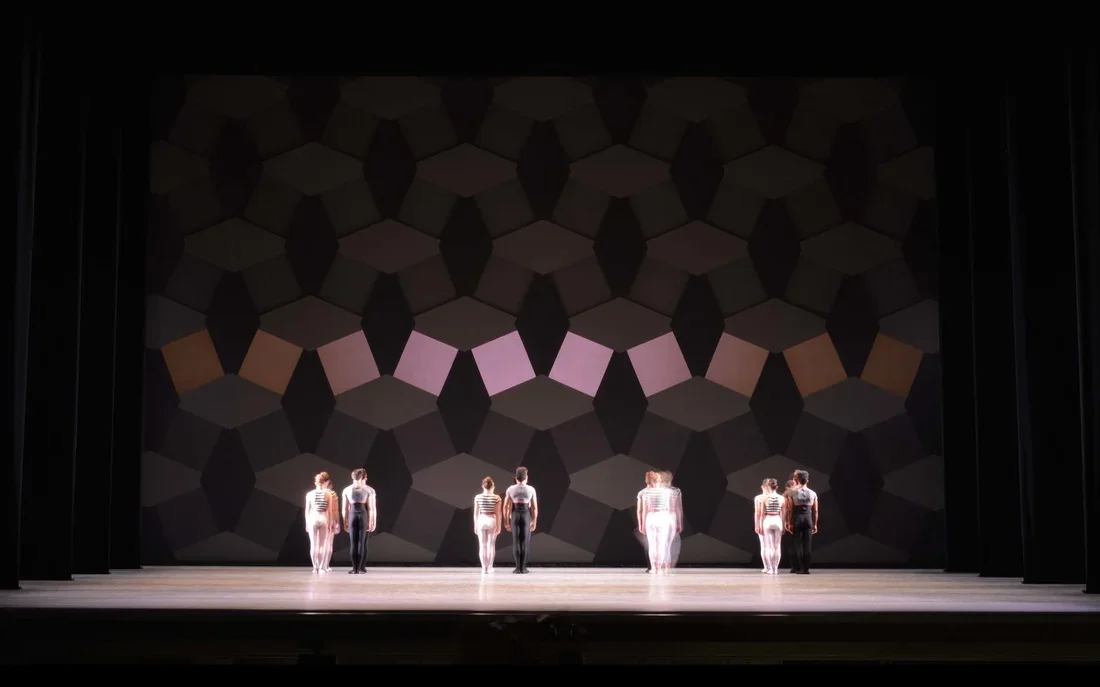
The choreography behaves like compositional architecture, dancing along the edges of form. At moments it resembles cats moving across a squared surface, alert, precise, unpredictable, yet never chaotic. The striped costumes for the women and the bicolor palette for the men reinforce this dialogue with geometry, reminding us that composition is generated by blocks and relationships rather than by the isolation of individual fragments.
Everywhere We Go. Choreography by Justin Peck. Music by Sufijan Stevens. Photo Credit Paul Kolnik.
The projected design, the lighting, the diagonals cutting across space, everything suggests a molecular world. And perhaps that is why it feels so intelligent to watch structure gently deconstructed rather than aggressively dismantled. There is no rebellion against form here. Instead, there is fluency within it.
And then there is the music. Sufjan Stevens delivers everything one might hope for, and then stretches it further. The score carries you toward the edge while keeping you suspended in balance. It plays in conversation with the grids, the boxes, the invisible compartments shaping the stage. What emerges is an orchestrated game between sound and space.
In the end, the ballet became exactly what I expected, and more importantly, something larger than expectation.
What Is It?
Everywhere We Go is a large scale ensemble ballet created for New York City Ballet by Resident Choreographer and Artistic Advisor Justin Peck. The work premiered during the Company’s 2014 Spring Gala and marked Peck’s sixth ballet for the institution, signaling his rapid ascent as one of the defining choreographic voices of his generation.
The production features an original nine movement commissioned score by Sufjan Stevens, written for a full orchestral environment. It was Stevens’ first commission from the Company and his second collaboration with Peck, following Year of the Rabbit.
Everywhere We Go. Choreography by Justin Peck. Music by Sufijan Stevens. Photo Credit Paul Kolnik.
The ballet brings 25 dancers continuously into motion, favoring collective presence over star centered hierarchy. Visually, the stage environment is shaped by sets from Brooklyn based artist and architect Karl Jensen, costumes designed by former NYCB Principal Dancer Janie Taylor, and lighting by Brandon Stirling Baker, one of Peck’s most trusted collaborators.
Notably, the work is non narrative. There is no linear storyline guiding the audience. Instead, the ballet operates as choreography built directly from musical structure, spatial relationships, and shifting visual architecture.
Why It Matters
When Everywhere We Go premiered, major ballet institutions were confronting a familiar question: how can tradition remain alive without hardening into preservation?
This work answered with clarity.
Peck leaned toward youthful momentum, interdisciplinary collaboration, and a design forward stage language. Rather than rejecting classical vocabulary, he expanded its possibilities, demonstrating that contemporary culture can inhabit historic institutions without diluting their rigor.
Everywhere We Go. Choreography by Justin Peck. Music by Sufijan Stevens. Photo Credit Paul Kolnik.
More than a decade later, the ballet continues to feel strikingly current. That endurance is often the true measure of artistic intelligence.
The piece is frequently regarded as part of a broader movement that helped redefine the contours of American ballet, not through provocation, but through confident evolution.
The Music: Sufjan Beyond Category
Sufjan Stevens is widely associated with intimate songwriting and the textures of indie folk, yet this commission reveals the breadth of his compositional reach.
The score blends minimalism, layered brass, rhythmic propulsion, and expansive orchestration while preserving the melodic sensitivity that defines his musical voice. One can sense subtle affinities with the lineage of American minimalism, though the language remains distinctly his own.
Everywhere We Go. Choreography by Justin Peck. Music by Sufijan Stevens. Photo Credit Paul Kolnik.
What makes the music particularly compelling in a ballet context is its spatial awareness. It does not simply accompany movement. It constructs an environment for it.
For emerging creators, there is a quiet lesson here: artistic identities should remain permeable. The most enduring artists resist the gravitational pull of categorization.
The Choreographic Language
Justin Peck’s movement vocabulary in this ballet is immediately recognizable once the eye adjusts to its speed and density.
Directional changes arrive quickly. Diagonal pathways slice through the stage. Group formations expand and contract with kaleidoscopic precision. Footwork remains athletic yet musical, allowing rhythm to travel visibly through the body.
At times, the stage resembles an animated city grid, alive with intersecting trajectories.
Everywhere We Go. Choreography by Justin Peck. Music by Sufijan Stevens. Photo Credit Paul Kolnik.
Importantly, the choreography resists prolonged centrality. No single dancer dominates for long. Instead, the viewer’s attention migrates across the ensemble, reinforcing the ballet’s underlying meditation on shared momentum.
The title begins to read less like a phrase and more like a condition. Movement is constant. Presence is distributed.
The Visual World
Karl Jensen’s set introduces suspended geometric forms rendered in saturated color. Rather than attempting scenic realism, the structures behave like spatial frames, guiding perception and subtly reshaping the stage as the ballet progresses.
Janie Taylor’s costumes extend this architectural logic. Stripes, color blocking, and tonal contrasts emphasize relational composition, allowing the dancers themselves to function as moving components within a larger design system.
Everywhere We Go. Choreography by Justin Peck. Music by Sufijan Stevens. Photo Credit Paul Kolnik.
Brandon Stirling Baker’s lighting completes the environment with directional clarity, carving diagonals across space and heightening the sense that what we are witnessing is less a decorated stage than a constructed world.The overall effect communicates a ballet firmly situated in the present tense.
Why It Still Feels Current
Some works age by becoming artifacts. Others remain alive because their ideas continue to circulate within the culture.
Everywhere We Go belongs to the latter.
Everywhere We Go. Choreography by Justin Peck. Music by Sufijan Stevens. Photo Credit Paul Kolnik.
Its interdisciplinary spirit, its fluid understanding of artistic identity, and its emphasis on ensemble intelligence mirror the way contemporary creative ecosystems increasingly operate.
More than a repertory piece, the ballet behaves like a living laboratory, one that reminds us institutions remain vital when they invest in new creation rather than nostalgia.
A Closing Reflection
Some works attempt to safeguard tradition. Others quietly redraw its edges.
Everywhere We Go does the latter with composure and confidence, offering a vision of structure that is neither rigid nor fragile, but elastic enough to invite reinvention.
Photo by Paul Kolnik.
Explore more performing arts coverage on TMN®.
Ready to start YOUR CAREER IN CULTURAL JOURNALISM?
TMN® New Media Coverage Course. Enrollment now open.
TMN®. Experiential learning. Real media. Real work.
Comparte este post: