GEESE
Do We Still Believe in Music Discovery?
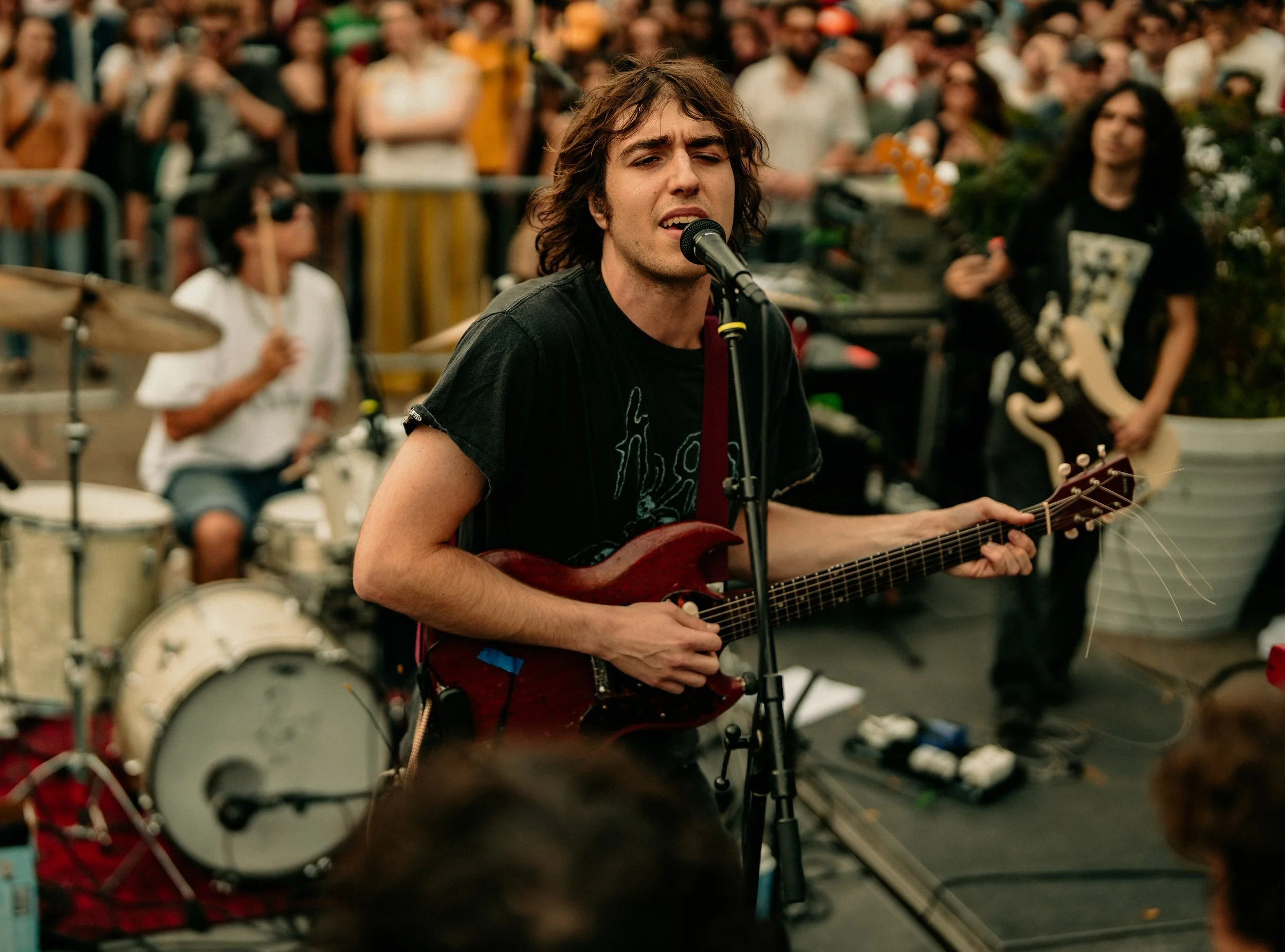
Geese live at Banker’s Anchor by Tommy Krause.
When I was covering ACL Festival in 2024, I stopped by one of the smaller stages where a handful of people were waiting to see Geese. At that time, they were just another name on the lineup, playing a mid tier stage under the harsh Austin sun at 3 PM. Maybe 250 people in the crowd.
Then the music started.
I immediately felt I had been missing something. This was not just another band. There was something about them that felt real. And the voice of Cameron Winter caught my attention right away.
At one point during the set, Cameron started telling a story about his first visit to Austin and an encounter with a cat eyed barista. It was a moment that led into the song “Islands of Men”. For no particular reason, I took out my phone and recorded it.
The video stayed on my phone for almost two years. Then one day, while reviewing archival footage for publication, I came across it again. We decided to release it.
Today, that video has over 100K views across different short formats. But what surprised us most was not the reach. It was the reaction.
More than half of the comments express some kind of frustration, especially toward Cameron Winter. Comments range from “overrated band” to “he is high,” some with hundreds of likes. Others defend the band, but the overall tone leans negative.
This reaction didn’t happen in isolation. Around the same time, a podcast interview with marketing executives from Chaotic Good Projects circulated online, where they discussed strategies used to build buzz around emerging artists. That conversation triggered a wave of backlash. For many listeners, it felt like discovering that something they connected with was, in part, engineered.
The story gained traction. Wired published an article titled “The Fanfare Around the Band Geese Actually Was a Psyop.” Shortly after, Rick Beato questioned whether this was an “industry plant” case, comparing Geese’s numbers with other independent artists. Anthony Fantano also responded, pushing back against the backlash.
But the most interesting part of this situation is not Geese themselves.
It is how quickly we forget how the music industry works.
Marketing has always been part of music. What feels different now is the visibility of those mechanisms. When the process becomes visible, the illusion breaks. And for many listeners, that feels like betrayal.
There is also a clear double standard. In mainstream pop, heavy marketing is expected. In indie music, it is often perceived as inauthentic.
So the question becomes simple:
Does the music still matter?
In my opinion, yes. Geese is a strong band. A very strong band. What they are doing stands on its own. Whether there was a marketing push behind them does not erase that.
And this is not unique. Major labels invest heavily in positioning artists, building narratives, shaping perception. Not always through lies, but through carefully constructed stories that create the right impression at the right time.
I understand why people feel misled. That reaction is real.
But I think the focus is misplaced.
What matters is not how you arrived at the music. What matters is what happens when you listen.
Do you connect with it or not?
At ACL in 2024, I had no context, no narrative, no discourse. Just a band playing in the heat at 3 PM. And I walked away thinking the same thing I think now.
The band is good.
That’s it.