Daisy Chain Fields
Olivia Rodrigo Raises $20M While Bringing Generations of Women in Music Together
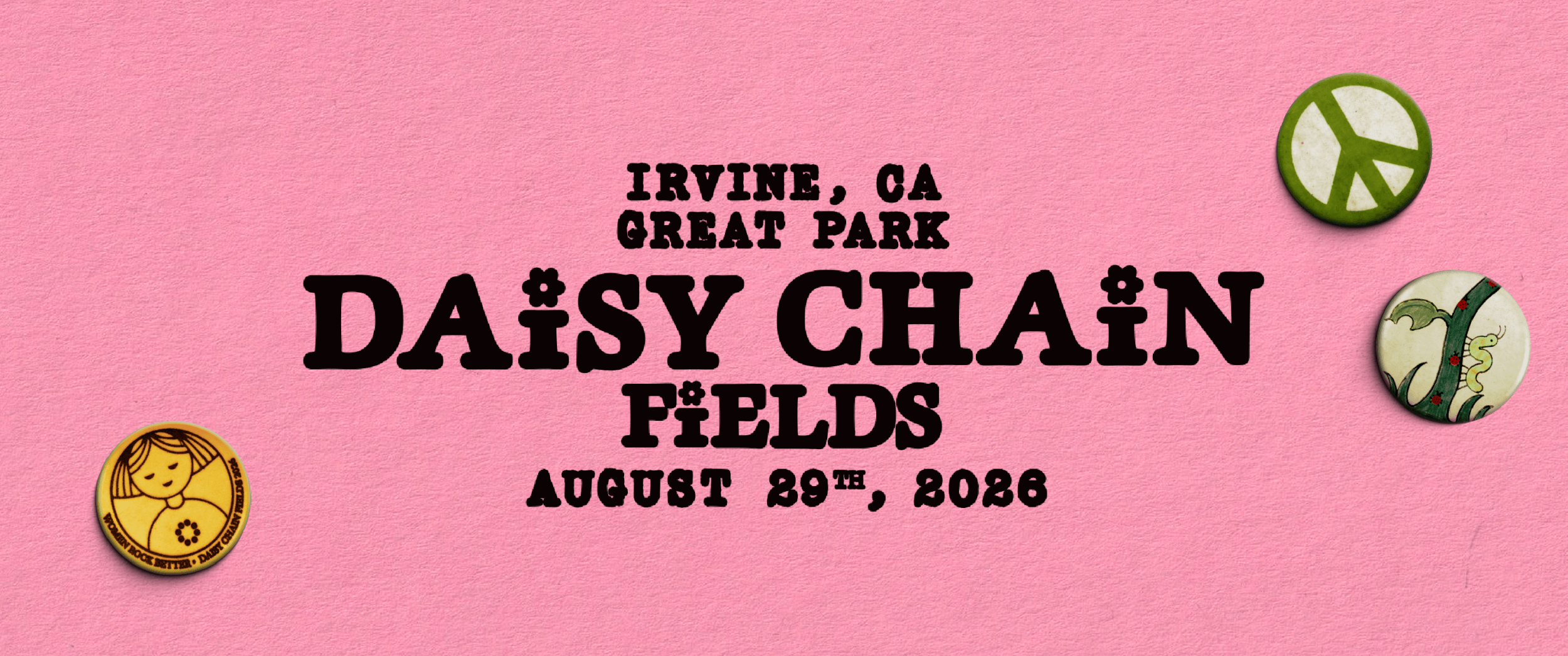
The inaugural festival brought Chappell Roan, Doechii, Mitski, Bikini Kill, Garbage, The Breeders and more to Irvine, California, while directing $20 million to organizations working with women and girls.
LOS ANGELES | TMN Editorial
Olivia Rodrigo launched the first edition of Daisy Chain Fields on Saturday, August 29, at Great Park in Irvine, California, with a lineup that connected several generations of women in music.
Rodrigo headlined a bill that included Chappell Roan, Doechii, Mitski, Bikini Kill, The Breeders, Garbage, Santigold, Rachel Chinouriri, Die Spitz and other artists. KATSEYE had also been scheduled to perform but withdrew shortly before the festival after member Megan injured her ankle; Devon Again was added to the lineup.
The lineup was deliberately broad. Bikini Kill and The Breeders shared the festival with artists whose careers emerged decades later, while Doechii, Chappell Roan and Rodrigo represented a current generation operating on a very different scale of pop culture.
Chappell Roan - Subway (Live at Daisy Chain Fields 2026). Video by I’m Bea.
That intergenerational approach also appeared during Rodrigo’s closing set. Sarah McLachlan joined her for “Building a Mystery” and “Angel”; Alanis Morissette appeared for “Ironic”; and Stevie Nicks performed Fleetwood Mac’s “Landslide” with Rodrigo. Karen O had originally been announced as a special guest but was unable to attend because of a family emergency.
From Lilith Fair to Daisy Chain Fields
Rodrigo has identified Lilith Fair as a direct influence on the festival. Founded by McLachlan in 1997, Lilith Fair was created partly in response to an industry where promoters routinely resisted booking several women consecutively on the same bill. Its original run from 1997 to 1999 raised roughly $10 million for charity.
At Daisy Chain Fields, Rodrigo acknowledged that history directly, telling the audience before performing with McLachlan that without Lilith Fair, “there would be no Daisy Chain.”
There were other decisions that separated the festival from a standard multi-stage event. Rodrigo personally approached performers, rather than leaving the invitations entirely to agents, and the schedule was designed without competing performances between its two main stages. Artists were also presented with equal-sized billing on the lineup rather than being arranged through the usual visual hierarchy of festival posters.
The music, however, was only one part of the model.
Olivia Rodrigo - My Way (Live at Daisy Chain Fields 2026). Video by I’m Bea.
Net proceeds from Daisy Chain Fields were directed to ten nonprofit organizations working across reproductive health, maternal health, gender-based violence, workplace rights, legal advocacy and access to basic services. They included Baby2Baby, Black Mamas Matter Alliance, Center for Reproductive Rights, FreeFrom, Jhpiego, Johns Hopkins Center for Indigenous Health, National Domestic Workers Alliance, National Institute for Reproductive Health, National Women’s Law Center and Planned Parenthood.
Ahead of the event, Rodrigo announced that the festival had generated $10 million for those organizations. During her set, Melinda French Gates announced that Pivotal Ventures would contribute another $10 million, bringing the total to $20 million.
The nonprofits were also present at the festival through a dedicated philanthropy area where attendees could learn about their work. AP reported booths addressing reproductive healthcare, domestic workers’ rights and Black maternal health, alongside installations by artists including the Guerrilla Girls.
The festival’s website also featured work from women artists and products from women-led businesses and makers.
Doechii And Chappell Roan Sharing a moment Backstage at Daisy Chain Fields Festival 2026. Video by
L26.
But who builds the infrastructure?
Daisy Chain Fields also raises a less straightforward question.
A festival centered on women, nonprofits and social issues might suggest an alternative to the usual music-industry structure. Daisy Chain Fields is not that.
The event was produced by C3 Presents and Live Nation, two of the biggest operators in the global festival business. Its official list of partners and associates includes companies such as Interscope, Universal Music Group, Amazon Music, Sony Music Publishing, Verizon, Taco Bell and LEGO, alongside local venue partners and women-led businesses.
Rodrigo herself works within the major-label system through Geffen/Interscope and Universal Music Group.
There is a tension in that arrangement. If part of the ambition is to shift resources and opportunity toward women and organizations that are often excluded from positions of power, another approach could involve building more of the festival through independent promoters, independent media, smaller production companies and businesses owned by the communities the event aims to support.
That would distribute not only the festival’s proceeds differently, but some of the money required to produce the festival in the first place.
But it would also mean giving up part of the infrastructure that makes an event on this scale possible.
C3 and Live Nation can provide venues, ticketing systems, production teams, artist logistics, security, sponsorship infrastructure and access to an established festival network. Working inside that system allowed Daisy Chain Fields to put major artists on two stages, attract a large audience and move millions of dollars toward its nonprofit partners in its first year.
So the question is not simply whether Rodrigo should or should not work with major corporations.
It is whether using the existing music industry differently is enough, or whether changing the industry also requires building different structures around the music.
Daisy Chain Fields currently belongs to the first model. It uses a highly corporate festival infrastructure and redirects part of what that infrastructure can generate toward a defined group of causes.
That distinction does not diminish the $20 million.
For organizations working on maternal health, reproductive rights, domestic workers’ protections or gender-based violence, the funding is real. AP also reported that the grants were structured to give organizations flexibility to address their own priorities and underfunded needs rather than restricting the money to predetermined projects.
It does, however, make Daisy Chain Fields more interesting to examine than a simple story about an artist launching a festival for a good cause.
The event brought artists separated by decades of music history onto the same bill, connected a young audience directly with nonprofit organizations, and generated substantial funding in one day. At the same time, it did so using many of the same corporations and systems that already control a large part of the contemporary music business.
Those two realities can exist at the same time.
After its first edition, Daisy Chain Fields has demonstrated what an artist with Rodrigo’s reach can do within the existing industry. Whether future editions also begin to question who gets to build, produce and economically participate in that industry is another matter.
The Breeders - Cannonball (Live at Daisy Chain Fields 2026). Video by HBwalter77.