LEARNING BEYOND LABELS
When we discover what we are capable of
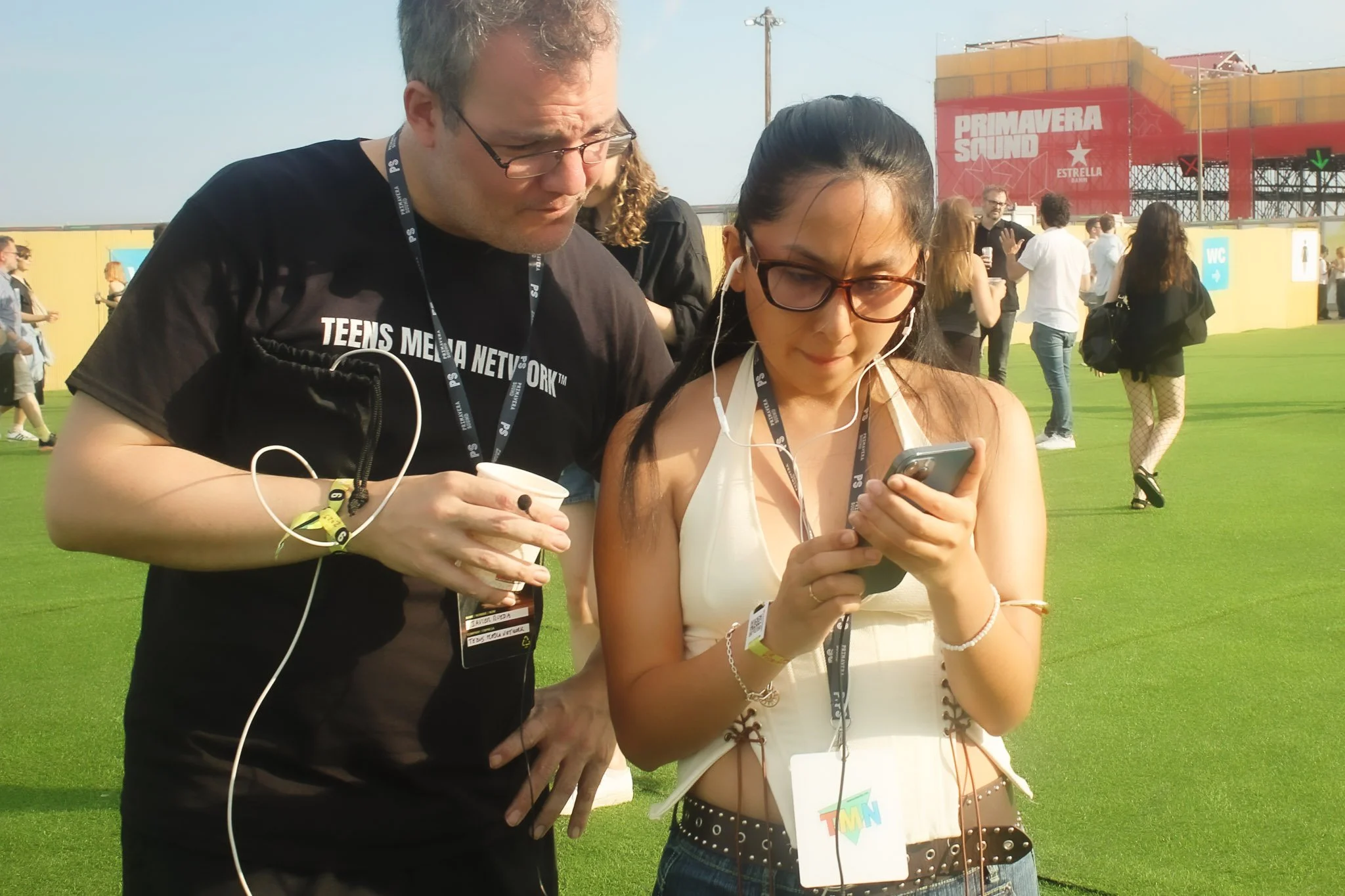
A TMN mentor and creator working together at Primavera Sound Festival in Barcelona.
What happens when education gives us space to discover what we are capable of instead of asking us to decide too early who we are supposed to become?
TMN Creative Thinking
In this episode of TMN Creative Thinking, TMN creators Hasi Kapali and Emil Cinto interview Teens Media Network founder Pablo Herrera during the Big Picture Learning Big Bang Conference 2026 in Dallas, Texas.
The conversation moves through Pablo’s path from industrial design to media and education, the influence of living in Argentina, Spain and the United States, the pressure young people face to define their professional identities, the role of artificial intelligence in education, and why making mistakes and working across generations are important parts of learning.
It also provides some context for the ideas behind Teens Media Network and why TMN uses real projects, media and popular culture as spaces for young people to learn through experience.
From design to media and education
Pablo’s professional path began with industrial design. He studied at an architecture school in Argentina before moving to Spain, where he continued exploring different creative fields. He eventually completed a master’s degree in arts and produced a documentary as his thesis, an experience that introduced him to media production.
But his relationship with media changed significantly with the arrival of the first consumer digital cameras.
Before mobile phones incorporated cameras and years before creating and distributing video online became commonplace, these relatively inexpensive devices made it possible for people without access to professional filmmaking equipment to start experimenting with moving images.
Pablo began making videos with them and soon became interested in what could happen if that same access was extended to other people.
“I started creating movies with those devices, those digital cameras, by myself. From that I said, okay, cool, we can create a festival to encourage common people to create movies.”
That idea became the “Festival de miniMETRAJES” (miniFILM Festival), a project created in Spain around 2004 that invited people to make films using accessible digital technology. The festival eventually reached audiences in Spain and Latin America.
The project also opened an unexpected path into education. After seeing the festival, the local government invited Pablo to bring those same digital devices into public schools and use them to teach filmmaking.
“That was how I started my career in education and with young people.”
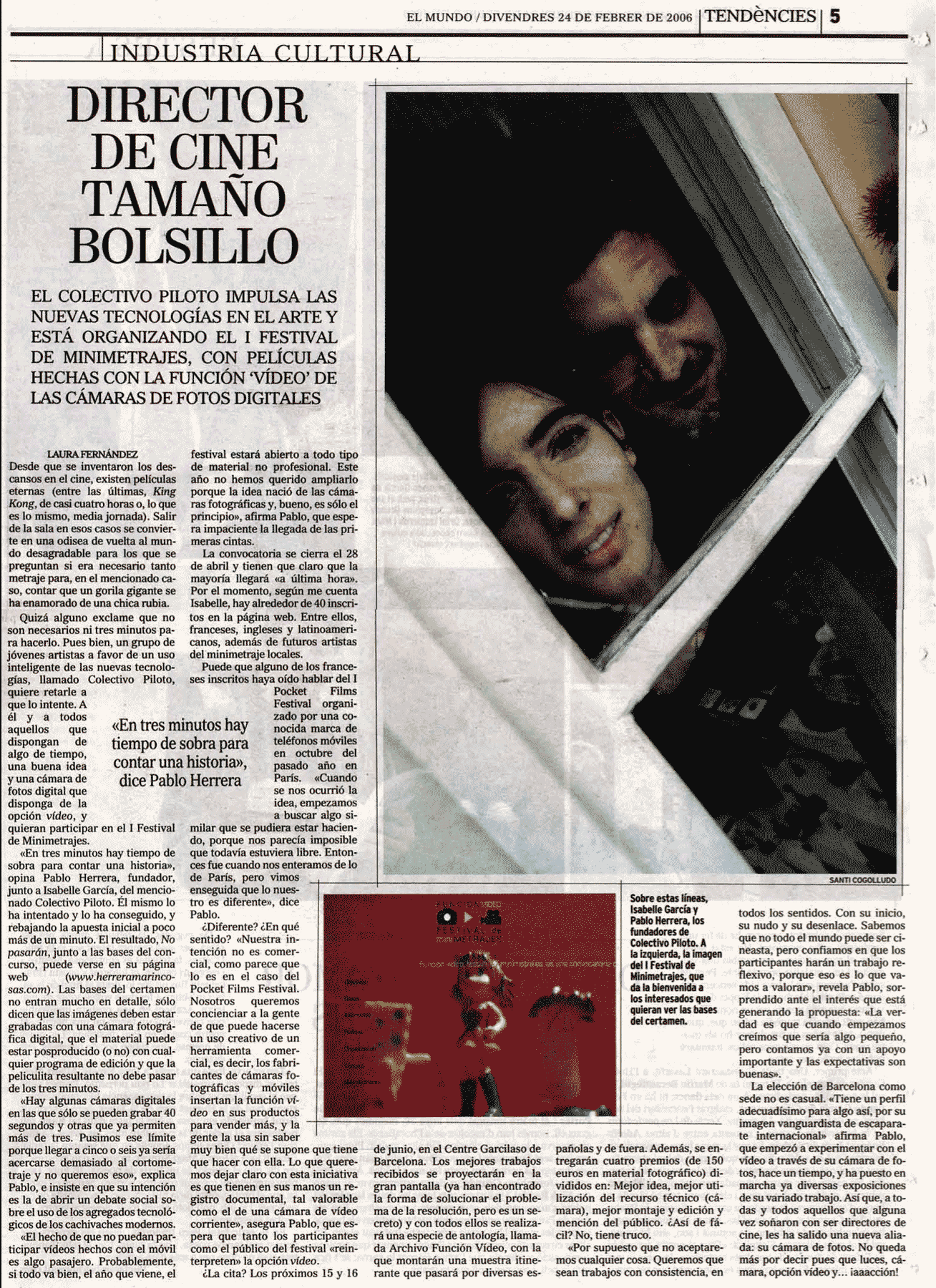
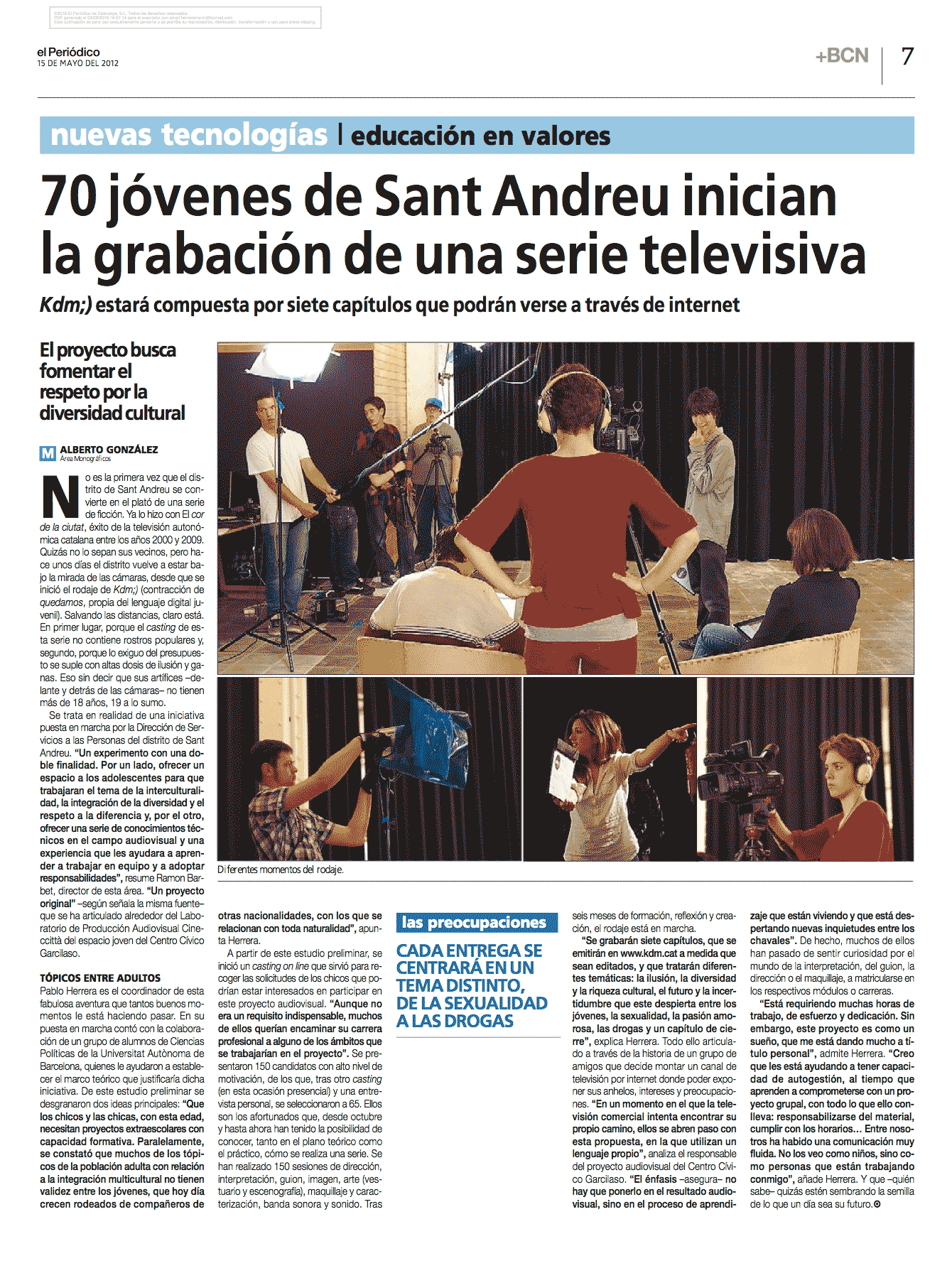
In the images: press coverage of Pablo’s early media education work. From organizing an amateur film festival to working with young people in public schools, what began as an experiment with new technology gradually became a way of exploring how access to creative tools could help people discover abilities they didn’t necessarily know they had.
How different cultures shape the way we think
The conversation then moves through the different places where Pablo has lived: Argentina, Spain and the United States.
Rather than identifying one country as the origin of his approach, he describes different things he took from each culture.
From Argentina, he associates his experience with curiosity and the tendency to find ways of solving problems with whatever resources are available.
From Spain, he highlights the importance of cultural life and the presence of young people in film festivals, music festivals and other cultural activities. Living there also exposed him to a model in which public institutions played an important role in supporting cultural projects.
Moving to the United States introduced another perspective: entrepreneurship and the possibility of building projects without depending entirely on public founding.
The move itself was also a significant personal risk. Pablo arrived in the United States at 39 after leaving his life in Spain and without speaking English, something he had wanted to learn for years.
“It was very, very difficult. But I got it done. I don’t regret it.”
For Pablo, living in different places has been less about replacing one identity with another than accumulating different ways of looking at the world. That is also why he encourages young people, when possible, to spend time outside the place where they grew up.
“Every place that I lived taught me something.”
The experience of moving between countries also reinforced something that appears throughout the conversation: the idea that a person does not necessarily need to be defined by one place, profession or predetermined path.
Why education shouldn't force young people into labels
At Big Bang, that question connects directly with the work of Big Picture Learning and its emphasis on learning through real-world experiences.
For Pablo, one of the problems with traditional education is the pressure to make major decisions about professional identity very early.
“When you are 17, 18, even 20, in your 20s, you don’t really know what you want to do, but society is pushing you to pick something.”
He recognizes that pressure from his own experience.
Even within creative industries, people are often expected to identify themselves through a specific profession: photographer, filmmaker, designer, writer or another recognizable category. Pablo describes never feeling entirely comfortable fitting into only one of those boxes.
“I always loved to be a little bit of all those things.”
That can create friction with systems designed around clearly defined professional roles. At the same time, changes in technology and media have created professional possibilities that did not exist twenty years ago. Someone can now build an audience through YouTube or develop a career around forms of digital creation that previously had no established professional category.
This is one reason Pablo argues that education should provide more opportunities for exploration before demanding specialization.
“I think that education should be right now more about creating spaces where young people — and not even young people, but also adults — can discover what they are capable of.”
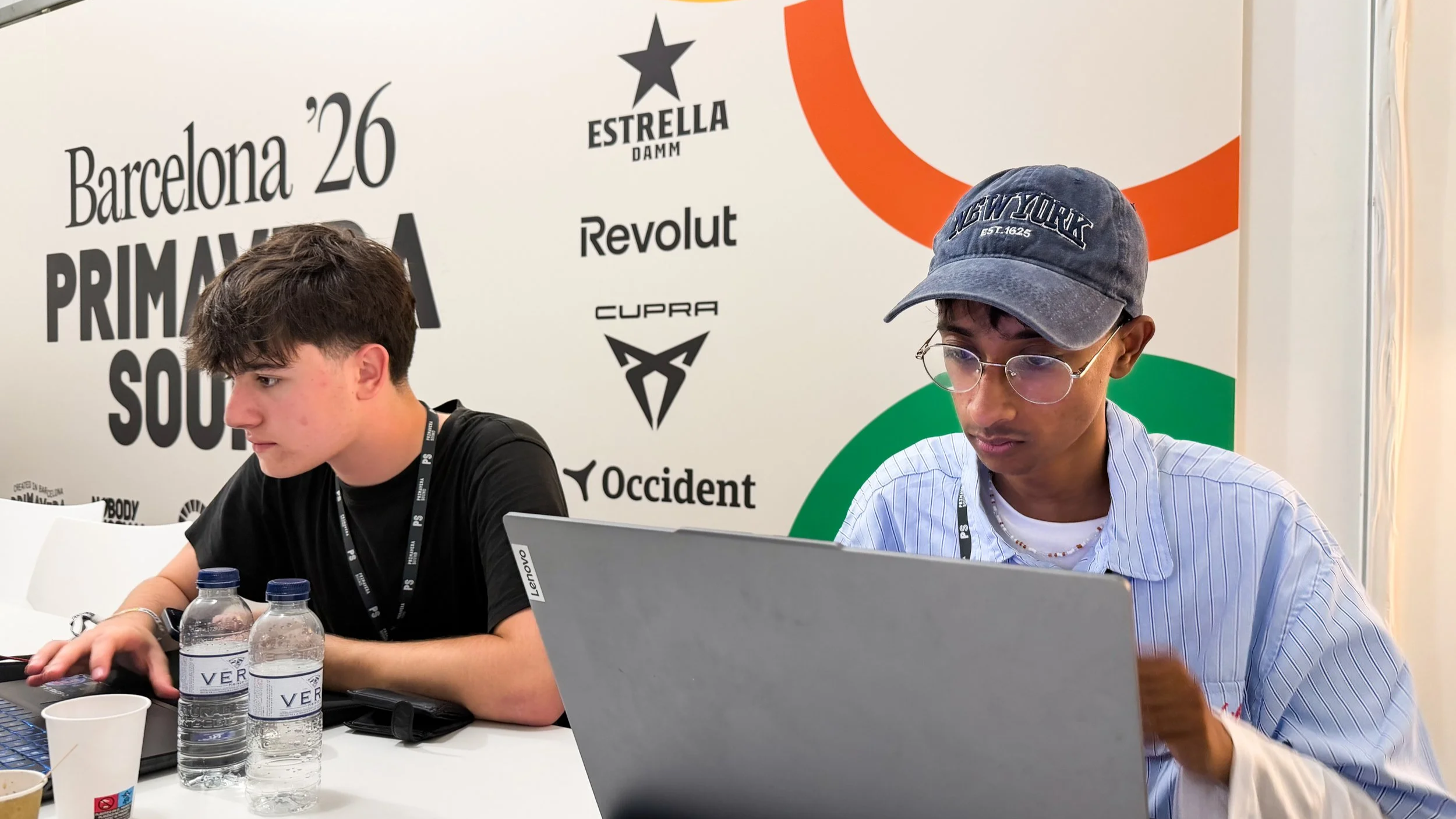
TMN creators working in the Press Lounge at Primavera Sound in Barcelona. Real spaces allow people to discover what they’re capable of through real experiences, not simulations.
He connects that idea back to his experience with digital cameras. He did not initially need to define himself as a filmmaker or attend film school in order to begin making films. He just needed access to a camera.
The important moment came through doing something he had not previously imagined himself capable of doing.
“If you enter a blank canvas and you achieve something that you were not thinking capable of, that is the best gift that you can give to someone connected with a real thing.”
Formal education can still provide opportunities to refine those abilities later. But discovery can happen before specialization, and access to the right tools and experiences can sometimes reveal possibilities that a predefined professional label cannot.
AI and the future of learning
Artificial intelligence introduces another challenge to traditional ideas about what people need to learn.
Pablo argues that education systems have historically placed significant emphasis on memorizing information. AI can now retrieve, organize and process much of that information almost instantly, changing the role that educators need to play.
“You don’t need the lecturer telling you exactly how history was. You can research that. But what we need now is a lecturer helping you use that technology to achieve that result or that level of knowledge.”
During Big Bang, Pablo heard a young participant explain that her university discouraged the use of artificial intelligence, while her professional workplace expected her to use AI tools.
For him, that contradiction illustrates a growing disconnection between some educational environments and the reality students encounter when they enter the workforce.
The conversation compares the current resistance to AI with the introduction of scientific calculators. Technologies that were initially prohibited in classrooms eventually became ordinary tools.
That does not mean replacing human thinking with artificial intelligence.
Instead, Pablo argues that educators and young people need to understand how to work with these technologies while also recognizing what machines cannot provide.
“It’s not replacing your mind with artificial intelligence. It’s to realize that we are right now working with machines, and we have to learn how to work with that.”
That shift could also change which abilities education prioritizes.
Rather than concentrating primarily on accumulating information, Pablo points to human and professional skills that remain essential: meeting deadlines, communicating effectively, understanding professional expectations, making decisions and knowing how to work with other people.
“These are the things that you have to learn in school that maybe nobody will teach you.”
For him, those abilities become more important, not less, in an environment where machines can increasingly perform technical and informational tasks.
Why mistakes are essential for growth
When Hasi asks what advice Pablo wishes someone had given him when he was younger, he reframes the question around a broader philosophy.
Every generation, he says, has a tendency to criticize the generations that come before and after it. Instead of approaching young people from that position, he believes mentors should share what they know while accepting that they are also learning.
His advice is to explore, make mistakes and find mentors who can provide guidance without expecting perfection.
“Find the mentors, those people that you believe can guide you not by perfection, but those people that can understand you.”
A mentor may have accumulated experience that allows them to recognize professional situations before a younger person does. They can explain why communication matters, why a deadline has to be respected or why a particular decision might create a problem.
But that transfer of experience does not need to happen through punishment.
“It is about sharing an experience.”
Mistakes are part of that process because the consequences of making them in a learning environment can be discussed, understood and used before similar mistakes carry much greater consequences later in someone's professional life.
“Don’t be afraid of failure because failure makes you improve very fast.”
The relationship also works in both directions.
Pablo describes growing up in an analog world and eventually arriving in one shaped by artificial intelligence. Younger generations have developed around technologies, behaviors and cultural references that older generations did not experience in the same way.
For that reason, he does not see mentorship as a relationship in which knowledge moves exclusively from the older person to the younger one.
“I also learn from creators. I’m learning from you as young people because you are teaching me or sharing things with me.”
The conversation eventually returns to Pablo’s own experience of questioning adults when he was young. He remembers challenging things that were presented as unquestionable and being treated as problematic because he did not always want to adapt to existing systems.
His conclusion is not that every rule should automatically be rejected, but that confusion, mistakes and questioning can sometimes become opportunities for discovery.
“Maybe you don’t have to adapt. Maybe you have to break the system and rebuild it.”
Not knowing exactly what to do next does not necessarily mean something has gone wrong. It can also create space to discover another direction.
Why TMN exists
The final part of the conversation connects these ideas directly to Teens Media Network.
When Hasi asks about the role of popular culture within TMN, Pablo begins with a simple explanation.
“I created TMN because I love music and I love creative things, and I love to break the rules.”
Popular culture has always been part of how young people understand themselves and communicate with each other. Pablo recalls growing up with musicians such as Madonna challenging social conventions while many traditional educational environments treated popular culture as something that belonged outside the classroom.
TMN approaches that relationship differently.
The network was created as a space where young people can make media, express ideas, experiment, make mistakes and at the same time learn how to produce work at a professional enough standard to exist publicly.
“I created this space for young people to express themselves, make mistakes, but also to be professional enough to create content.”
An important part of that idea is refusing to assume that media created by young people should only be interesting to other young people.
Pablo points out that much of TMN's audience is older than its creators. For him, that demonstrates that young creators are capable of producing photography, interviews, articles and videos that adults also choose to consume.
That connects to one of his criticisms of traditional education: the tendency to infantilize young people or create projects designed primarily to impress adults rather than allowing young people to participate in real cultural production.
TMN was created to test another possibility.
Young people can learn while producing something real. They can make mistakes while being expected to take their responsibilities seriously. They can work alongside adults without the relationship requiring either generation to pretend that one side has nothing to learn from the other.
And instead of asking them to decide immediately which professional label should define them, the process can begin with something much simpler: giving them access to experiences where they can discover what they are capable of doing.
TMN Creative Thinking is an original series by Teens Media Network exploring creativity, education, media and real-world learning through conversations with creators, mentors and professionals from our community.
This episode was recorded during the Big Picture Learning Big Bang Conference 2026 in Dallas, Texas, with TMN creators Hasi Kapali and Emil Cinto interviewing TMN founder Pablo Herrera.