REQUIEM
THEATER
Romeo Castellucci's first play at the Liceu left no one indifferent

A moment from the performance of Requiem. Photo: ©David Ruano.
Romeo Castellucci first play at the Liceu left no one indifferent, and I was no exception. When I went to see Mozart's Requiem, I didn’t expect to encounter what I saw. In fact, I’m still not sure if I fully understood it or if I have formed a clear opinion. That’s why, instead of making a definitive judgment, I prefer to try to explain it through the impressions of those who, after leaving the Liceu, generously shared their opinions with me. A warning: there are all kinds of viewpoints, and I think that’s the best thing that can happen to a work—sparking debate.
To provide some context, it's important to remember that Mozart's Requiem is his final composition, shrouded in mystery and tragedy. While writing it, seriously ill, he believed he was composing his own funeral mass. He passed away on December 5, 1791, leaving the work unfinished, and it was his student Franz Xaver Süssmayr who completed it. Thus, the Requiem has become marked as the musical testament of a genius who, in his final days, wrote about death while feeling it approach.
Romeo Castellucci takes this Requiem and transforms it into something radically different. His proposal is a multidisciplinary work that fuses music, theater, and visual arts to reinterpret the concept of death and transcendence. He moves away from the liturgical tradition to build a sensory experience that deconstructs the solemnity of the funeral mass into striking, symbolic images. One spectator summarized it precisely: "It is a plastic reimagination and reinterpretation of the Requiem," and I believe that's the best way to describe it.
The staging is striking, full of powerful images: trees emerging from the ground with earth included, walls covered in paint sprayed with hoses, like sophisticated graffiti, eventually revealing a crashed car. It all becomes a grand visual spectacle that, at least for me, was fascinating. However, the inevitable question arises: is this the Requiem that the Liceu attendees expected to see?
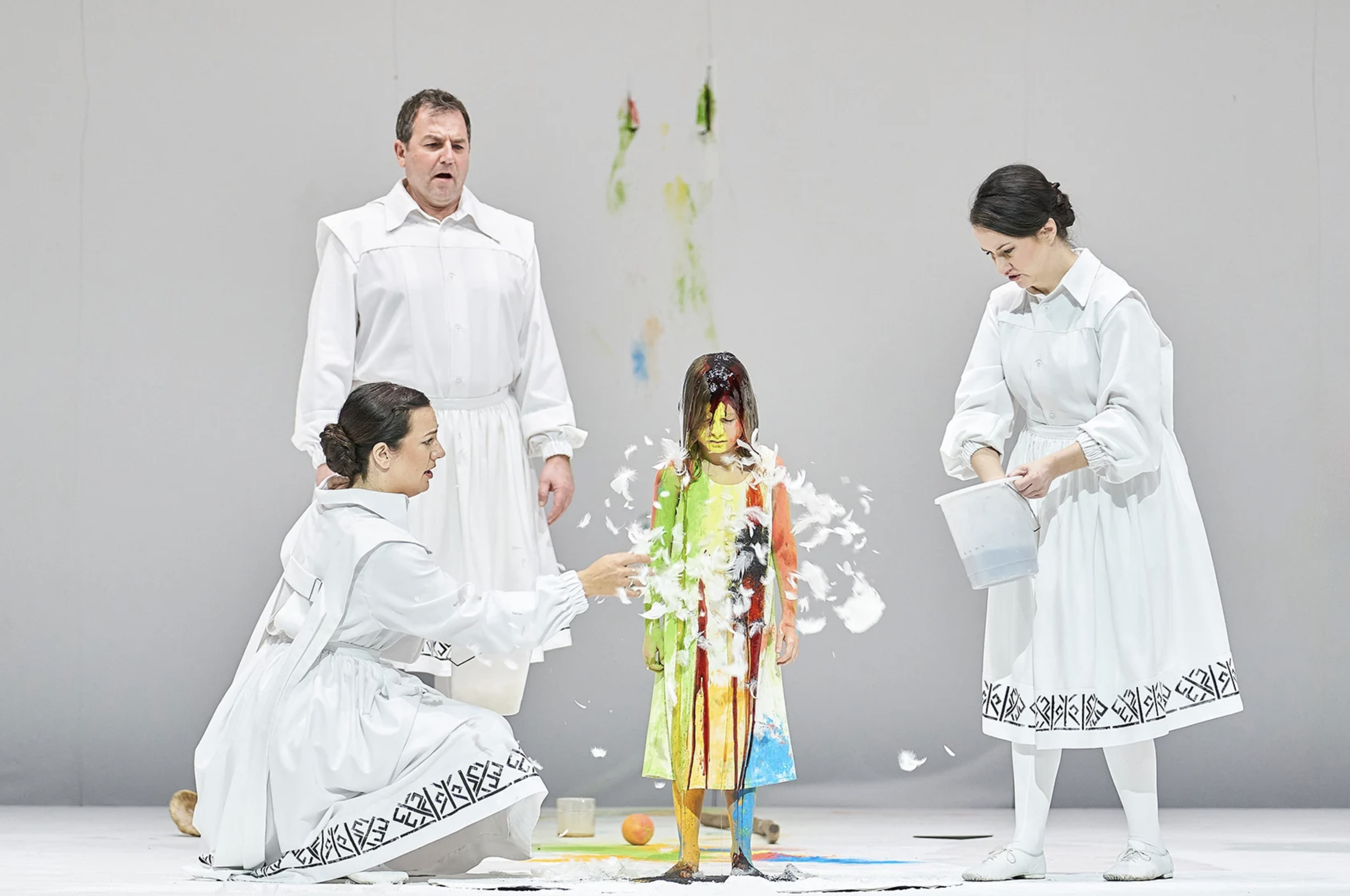
A moment from the performance of Requiem. Photo: ©David Ruano.
A lady commented to me politely: "I haven't seen my Requiem, the one by Mozart, but another one. There's nothing wrong with it, but it wasn't what I expected." Her younger companion replied: "But the Requiem is different nowadays. What is the Requiem? The Requiem of life, the Requiem of the planet?" The older woman countered: "But the music is by Mozart, right?" to which the other responded: "Yes, but it's adapted to the current circumstances. I found it marvelous. The visual aspect is impressive." The lady concluded with a doubt: "I came to see a Requiem and saw another one. I don't know, I have to think about whether I liked it or not. One thing distracted me from the other; the dance distracted me from the music." Her young companion looked at me and asked: "And what did you think?" I answered honestly: I hadn't been to the Liceu in a while, and this proposal had surprised and inspired me. She smiled and added: "Me too. It makes me want to come to the Liceu more if I see things like this."
“No he visto mi Réquiem, el de Mozart, sino otro. No tiene nada de malo, pero no era lo que esperaba”
Other opinions I heard reflected surprise and acceptance: "I liked it a lot, it wasn’t what I expected, but I think it’s good that I liked it." The choir sings while dancing, undressing, or playing with a skull. Castellucci takes theatricality to the extreme, creating an experience where music and image coexist, though not always in harmony. His staging relies on narrative fragmentation and an aesthetic that plays with the destruction and reconstruction of classical symbols: the resurrection of a body amid a devastated landscape, the gradual transformation of the stage into a chaotic space. Rather than illustrating the score, Castellucci confronts it with contemporary reality, generating a dialogue between Mozart’s work and the present.
“Está adaptado a las circunstancias actuales. Yo lo he encontrado maravilloso. La parte plástica es impresionante”
This Requiem by Mozart, transformed by Castellucci, urges us to reconsider the work from a renewed perspective. It invites us to explore concepts such as death, transcendence, and our relationship with art, in an exercise that challenges traditional ways of understanding music and representation. The greatness of this proposal lies not only in its reimagination, but in its ability to reinterpret the work in a way that doesn't just meet expectations, but questions them, creating a constant tension. Mozart's Requiem may remain the same, but through Castellucci’s eyes, it becomes something new—something that invites us to reflect not only on death, but also on our own being and the time in which we live.

A moment from the performance of Requiem. Photo: ©David Ruano.
The ending is apotheotic. Absolute silence. That moment of complete stillness becomes the perfect space for reflection. It is in that void where we find the true meaning of the piece, in the contrast between the familiar and what challenges us to discover. And that’s what Castellucci does: adapt the Requiem to the Requiem. Period. How wonderful that a work can generate so many opinions and such different visions among its audience. At least, a transgressive, original, and disruptive proposal is appreciated. Perhaps we should all watch Castellucci’s proposal and sit down to debate what we think, and talk about the true purpose of the Requiem: death, disappearance. Because, after all, that’s exactly what we’re doing.
Perhaps, in the end, we are all living our own Requiem.
Special consideration and thanks to Mar, the person who has helped me better understand these works. Moltes gràcies, Mar!
Share this post: